


An Analysis of the Armenian Elections and Their Geopolitical Implications

On June 7th, Armenians voted to reinstate Pashinyan and his party, Civil Contract, to lead their government. These elections have been touted as the most pivotal since Armenia’s independence in 1991, and in this case, the hype is warranted.
Pashinyan and his opposition represented two distinct paths. Pashinyan’s trajectory pushes Armenia towards Western alliances, diversifying relations, peace with Azerbaijan, and normalisation with Türkiye. Opposition parties want to continue relying on Russia, lean into Eurasian alliances, and maintain adversarial relations with Türkiye and Azerbaijan.
Given the divergence in the two sides’ foreign policy, Armenians were not just voting on the direction of their country but, by implication, the future of the South Caucasus. The South Caucasus, Georgia, Armenia, and Azerbaijan, are an important part of global trade, giving them outsized geopolitical weight. Russia, the US, and the EU have all weighed in on this election, turning it into a form of great power competition.
Though the election is finished and the votes have been counted, Armenia’s path is far from straightforward, and the geopolitical winners are yet to be determined.
The Primary Issue
At its core, Armenia’s election was a referendum on relations with Russia and peace with Azerbaijan. Armenia has been in conflict with Azerbaijan over Nagorno-Karabakh, also known as Artsakh, since 1988. During this time, Russia was Armenia’s ally and conflict mediator. However, far from moving towards a resolution, Azerbaijan and Armenia were caught in a cycle of frozen conflict, war, and mediation (Centre for Preventive Action, 2026).
This cycle shifted after Russia failed to assist Armenia in the 2023 war. Russian military ‘peacekeepers’ stood by as Azeris blockaded and finally took Nagorno-Karabakh (Centre for Preventive Action, 2026).
With the understanding that Russia was either unable or unwilling to aid Armenia, Pashinyan suspended Armenia’s membership in Russia’s security alliance CTSO (Meduza, 2026), bought weapons from France (Radio Free Europe & Radio Liberty Armenian Service, 2024), and pursued bilateral negotiations for peace with Azerbaijan (Goksel & Philip, 2024).
In 2025, Armenia and Azerbaijan invited the US to mediate in exchange for trade route opportunities. The US jumped at the opportunity, inviting both parties to DC, where they signed the framework for a peace agreement (The Guardian, 2025). Additionally, the US and the EU signed several deals with the goal of filling the Russian-shaped hole in Armenia’s security, energy, and economy (Eurasianet, 2025).

However, this assistance is largely contingent on peace with Azerbaijan and normalisation with Türkiye, neither of which are easy pills for Armenians to swallow.
The Opposition’s Path
As the leader of Civil Contract’s main opposition party, Strong Armenia, Samvel Karapetyan represents the Russian path. Karapetyan is a billionaire (Forbes, 2026) with direct business ties to Moscow and has Russian citizenship. Due to his Russian and Cypriot citizenships, Karapetyan cannot legally hold an elected office in Armenia (Armenpress, 2026). However, his nephew Narek Karapetyan agreed to stand in his place as party candidate until Samvel is able to renounce his other citizenships and the law is changed (The Armenian Mirror-Spectator, 2026)
Aside from Samvel Karapetyan’s personal ties to Moscow, his party’s platform is pro-Russia, wrapped in an appeal to traditionalism and nationalism. Strong Armenia’s worldview rests on the premise that Russia is Armenia’s traditional ally and that Armenia’s “security and prosperity is linked to a partnership with Moscow,” (Politpro, 2026). Their foreign policy pushes for deeper integration with Eurasian alliances and a distancing from the West. Karapetyan has warned against developing ties to Türkiye and Azerbaijan and antagonising Russia (Panorama, 2026).
The Russian-lite option is embodied in Armenia’s former president, Robert Kocharyan and his party, Armenia Alliance. Kocharyan also framed the election as a choice between two paths. He characterised Pashinyan’s path as turning Armenia into an “appendage of the Turkish world.” He claimed Armenia could get better terms on a peace deal and rejected the idea of any constitutional changes made under Azerbaijani pressure (The Armenian Report, 2026).
Election Interference
Several countries have left their fingerprints on Armenia’s elections; however, none have done more so than Russia. Historically, Russia has considered Armenia and the South Caucasus as part of its sphere of influence, referring to the region as Russia’s “near abroad.” Out of the three South Caucasus countries, Armenia has been Russia’s closest ally, and Russia seems unwilling to let go.
Weeks before the election, Putin challenged Armenia’s membership in the Eurasian Economic Union (EAEU), saying that Armenia cannot be in both the EAEU and the EU. He told Armenia that they must have a referendum to choose between the two. While Putin said that “a civilised divorce” was possible if Armenia chose the EU, he also said the “Ukrainian situation” started with Ukraine’s attempts to join the EU (Goble, 2026). Then Russia recalled its ambassador to Armenia (Inayatullah, 2026) and blocked several key Armenian imports from Russia, including brandy, fruit, flowers, and mineral water (Kokaia, 2026).
On the covert side, Russia propagated mass disinformation throughout Armenia, promoting pro-Russian parties and discrediting Pashinyan (The Insider, 2026; DEFRLab, 2026). According to Reuters (2026), Russia took interference to another level, and planned to send Russia-residing Armenians back to Armenia to vote in Moscow’s favour. Journalists have also reported that pro-Russian organisations in Armenia and Armenian organisations in Russia have offered to arrange plane tickets for Russian-based Armenians to fly to Armenia to vote in the election (Ambartsumyan & Udot, 2026; The Armenian Report, 2026).
The US
While Russia may have been the most audacious in its interference, it was not alone. The US also threw its weight around. About two weeks before the election, Secretary of State Marco Rubio visited Yerevan. During his visit, Rubio signed a charter on a Comprehensive and Strategic Partnership (Eurasianet, 2026). He also reestablished the US’s commitment to pursuing the Trump Route for International Peace and Prosperity (TRIPP). Trump also weighed in, tweeting, “Nikol [Pashinyan] has my COMPLETE and TOTAL Endorsement for ReElection,” (Turan, 2026).
Nothing new came from Rubio’s visit or Trump’s tweet, but it served to remind Armenians that Pashinyan is on good terms with the US and that such a relationship has huge potential to benefit Armenia. The US backed Pashinyan because it is hoping to open a trade route through the Caucasus, connecting Europe to Central Asia.
This route, TRIPP, is a hedge against China’s monopoly on mineral resources.
However, for the route to be viable, there needs to be peace between Armenia and Azerbaijan, and Pashinyan is the only realistic candidate willing to meet Azerbaijan’s demands.
Europe
Europe also came in on Pashinyan’s side. In the inverse of Russia’s trade restrictions, several European countries have made agreements to buy Armenian products. Latvia is buying Armenian flowers, Armenian apricots are being shipped to Poland, and the Netherlands announced it would open its markets to Armenian goods (ArmenianPress, 2026). On top of trade, the EU pledged to provide Armenia with financial assistance in the form of 50 million Euros (ArmenianPress, 2026).
Relationships with the US and the EU have numerous potential benefits and their own set of risks. There is a chance that the US’s war in Iran will make TRIPP non-viable, as the route runs along the Iranian-Armenian border. Without TRIPP, there is a real possibility that the US will lose interest in Armenia. Similarly, the EU’s slow and bureaucratic approach could leave Armenia waiting indefinitely for EU membership. The only guarantee Armenia has is Russia’s punitive measures.
Results
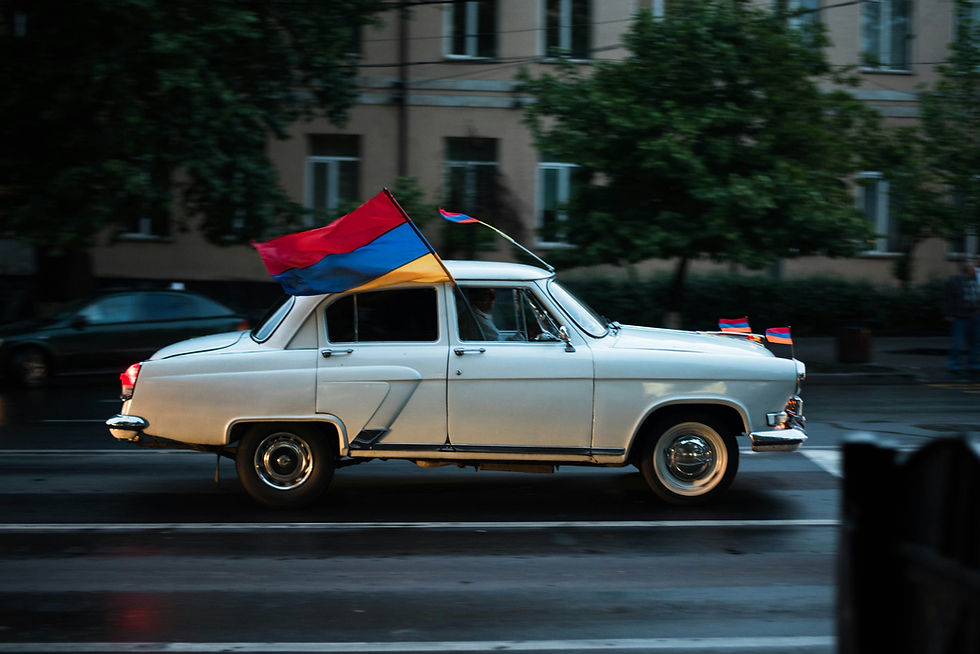
Despite the risks and difficulty, Pashinyan’s party, Civil Contract, won by a large majority. This result has been framed in several different ways: a rejection of Russia, support for a Western pivot, a choice of security over nationalism, and a vote to normalise relations with Türkiye and make peace with Azerbaijan. While the majority of Armenians voted for these outcomes, Pashinyan’s ability to fulfil them is still uncertain.
Civil Contract won 49.81% of the vote, giving them 61 seats in parliament. Samvel Karapetyan received 23.29% of the vote, equaling about 29 seats. Robert Kocharyan pulled 10%, which equals 12 seats, giving the opposition 41 of 105 seats (Oxmanqizi, 2026). While Civil Contract did unprecedentedly well, they did not get a super majority.
This is a problem for Pashinyan since his path forward rests on establishing peace with Azerbaijan. To codify the peace deal, Azerbaijan requires Armenia to remove the historical claims to Nagorno-Karabakh from Armenia’s constitution. To change the constitution, Pashinyan will need a super majority to pass a call for a national referendum (Oxmanqizi, 2026).
If Pashinyan is not able to wrangle support for a referendum, his government will be left in a foreign policy deadlock, and a lack of success will create an opening for the opposition in the next election.
Conclusion
While a deadlock is likely, Pashinyan’s failure is not inevitable. Instead of making a direct pivot to the West, Pashinyan could approach decoupling from Russia sideways. This may look like staying in Russia’s EAEU, while continuing to develop trade relations with individual European countries. It could also include normalising relations with Azerbaijan and Türkiye outside of signing a peace agreement. To a degree, this is already happening: border crossings between Türkiye and Armenia are being renovated for the future possibility of reopening the border (Ozerdem & Vartanyan, 2026). Even without a formal peace, Armenia can conduct relations with Azerbaijan through third parties, such as the US or Georgia. Establishing these relations will enable Armenia to be a part of global trade routes and keep the US engaged in Armenia. These moves towards diversification ensure that Armenia is not trading one dependency for another, but is securing their sovereignty.
Moving away from Russia is often framed in ideological terms, but it is the material benefits that matter. Opening Armenia up to trade, investments, alternative energy, and new opportunities will have a tangible impact on the lives of Armenians. However, if Armenia’s shift stagnates, if the US, the EU, Türkiye, and Azerbaijan disengage, Pashinyan’s path will fail to produce benefits, Russia will be vindicated, and Armenia’s status quo will remain.
References
Ambartsumyan, Hasmik & Udot, Roman. (2026. June 4). Voters are being sent to Armenia, supported by four forces, and working with the FSB. Fact Investigation Platform (FIP). https://fip.am/ru/49437
Armenian Mirror-Spectator. (2026, February 17). Russian-Armenian tycoon Karapetyan declared candidate for PM despite ineligibility. https://mirrorspectator.com/2026/02/17/russian-armenian-tycoon-karapetyan-declared-candidate-for-pm-despite-ineligibility/
Armenianpress. (2025, Jun 5). Armenian government rolls out new support measure for exporters amid Russian trade restrictions. Armenpress. https://armenpress.am/en/article/1252709
Armenpress. (2025 April 15). Samvel Karapetyan says he will renounce his foreign citizenships to seek office.Armenpress. https://armenpress.am/en/article/1247436
Balmforth, Slattery, Pamuk, and Papachristou (2026, May 29). Imported voters, fake websites: Russia’s covert efforts to stop Armenia’s pivot West. Reuters. https://www.reuters.com/world/imported-voters-fake-websites-russias-covert-efforts-stop-armenias-pivot-west-2026-05-29/
Centre for Preventive Action. (2026, February 18). Tensions between Armenia and Azerbaijan. Council on Foreign Relations. https://www.cfr.org/global-conflict-tracker/conflict/nagorno-karabakh-conflict
Eurasianet. (May 26, 2025). Rubio visit to Armenia gives Pashinyan boost. Eurasianet. https://eurasianet.org/rubio-visit-to-armenia-gives-pashinyan-boost
Eurasianet. (2025, January 15). Armenia forges strategic partnership with U.S, deepening Western ties. OilPrice.com. https://oilprice.com/Geopolitics/International/Armenia-Forges-Strategic-Partnership-with-US-Deepening-Western-Ties.html
Forbes Editor. (2026, March 10). Samvel Karapetyan. Forbes. https://www.forbes.com/profile/samvel-karapetyan/
Goble, Paul. (2025, May 12). Putin says Armenia and Russia can achieve a civilized divorce. The Jamestown Foundation. https://jamestown.org/putin-says-armenia-and-russia-can-achieve-a-civilized-divorce/
Goksel, N., Gamaghelyan, P. (2025, December 5). Seizing the moment: Armenia and Azerbaijan at a crossroads. War on the Rocks. https://warontherocks.com/seizing-the-moment-armenia-and-azerbaijan-at-a-crossroads/
Inayatullah, Siam. (2025). Russia recalls Armenia ambassador over EU ties. Deutsche Welle (DW).
https://www.dw.com/en/russia-recalls-armenia-ambassador-over-eu-ties/a-77354081
Kokaia, Lana. (2025, May 25). Russia bans Armenian alcohol, mineral water imports. Georgia Today. https://georgiatoday.ge/russia-bans-armenian-alcohol-mineral-water-imports/
Meduza. (2026, June 5). “We’ll decide and we’ll leave,” Armenian leader says of Russian-led defense bloc. https://meduza.io/en/news/2026/06/05/we-ll-decide-and-we-ll-leave-armenian-leader-says-of-russian-led-defense-bloc
Olari, V., Gelava, S., Gigitashvili, G., Grigoryan, A., & Tsetskladze, S. (2026, June 5). From Chisinau to Yerevan: How Russia’s Evrazia brought its Moldova playbook to Armenia. Digital Forensic Research Lab (DFRLab). https://dfrlab.org/2026/06/05/from-chisinau-to-yerevan-how-russias-evrazia-brought-its-moldova-playbook-to-armenia/
Osmanqizi, Sevinj. (2025, June 9). Armenia’s Pashinyan Won Enough to Stay in Power, but Not Enough to Secure Peace with Azerbaijan. Kyiv Post. https://www.kyivpost.com/opinion/77781
Ozerdem, A., Vartanyan, O. (2026, April 17). Türkiye-Armenia border reopening: Turning point for South Caucasus? Eurasianet. https://eurasianet.org/turkiye-armenia-border-reopening-turning-point-for-south-caucasus
Politpro. (2026). Uzhegh Hayastan. PolitPro. https://politpro.eu/en/armenia/political-parties/uzhegh-hayastan
Panorama. (2026, May 28). Karapetyan: Artsakh. Panorama.am. https://www.panorama.am/en/news/2026/05/28/Karapetyan-Artsakh/3160269
Radio Free Europe/Radio Liberty Armenian Service. (2024, June 18). Armenia, France Sign Another Arms Deal. Azatutyun. https://www.azatutyun.am/a/32997992.html
The Armenian Report Team. (2025, June 1). Alleged election travel scheme emerges as voters are transported from Russia to Armenia ahead of June elections. The Armenian Report. https://www.thearmenianreport.com/post/alleged-election-travel-scheme-emerges-as-voters-are-transported-from-russia-to-armenia-ahead-of-jun
The Armenian Report Team. (2026, June 5). Robert Kocharyan tells voters June 7 election will decide whether Armenia remains an Armenian state. The Armenian Report. https://www.thearmenianreport.com/post/robert-kocharyan-tells-voters-june-7-election-will-decide-whether-armenia-remains-an-armenian-state
The Guardian Staff & Agencies. (2025, August 9). Azerbaijan and Armenia sign peace deal at White House that creates a “Trump Route” in region. The Guardian. https://www.theguardian.com/world/2025/aug/09/azerbaijan-and-armenia-sign-peace-deal-at-white-house-that-creates-a-trump-route-in-region
The Insider. (April 23,2025). Kremlin bot network Matryoshka answers U.S. Senators' appeal to Meta and Google with wave of fakes about Armenia’s parliamentary election. The Insider. https://theins.press/en/news/291905
Tert. (2025, December 23). We will not achieve true peace by entering into distorted friendships with Azerbaijan and Türkiye, nor will we feel secure in the region by plotting against the Russia. Tert.am. https://tert.am/en/news/2025/12/23/Samvel%20Karapetyan/4254608
Turan, R. I. (2025, May 28). Trump endorses Armenia’s Pashinyan ahead of key parliamentary elections. Anadolu Agency. https://www.aa.com.tr/en/asia-pacific/trump-endorses-armenias-pashinyan-ahead-of-key-parliamentary-elections/3950075
Disclaimer
The opinions expressed herein belong solely to the columnist and do not represent the official position of our think-tank. Humanotions cannot be held liable for any consequences arising from this content. Content published on Humanotions may contain links to third-party sources. Humanotions is not responsible for the content of these external links. Please refer to our Legal Notices & Policies page for legal details and our Guidelines For Republishing page for republication terms.


Comments